
When you arrive in Vietnam for the first time, money quickly becomes not a theory but a practical issue. How to withdraw cash? Does your card work? Where to exchange dollars? Can you pay with your phone? What to do if your Russian card doesn't work? How much cash to carry? How not to be left without access to money in a taxi, hotel, or cafe?
For many, the first encounter with this reality happens right at the airport or at the hotel reception. The card in the phone doesn't work. The plastic card doesn't work. The ATM refuses. A person stands with a suitcase and suddenly realizes: "I should have figured this out earlier."
This article is not about investments or "how to make money." It's about everyday financial hygiene in Vietnam: what to keep on hand, what backup options to have, and why it's better not to travel with just one payment method.
Table of Contents
- Cash is Still Important
- Russian Cards: The Main Practical Surprise
- Where to Exchange Money
- ATMs and Fees
- Transfers, Friends, and "Send Me to the Card"
- Why You Need a Digital Backup Plan
- How We Solved the Issue with Bitget Wallet
- Separately About the Bitget Exchange
- What to Prepare Before the Trip
- How to Store Money on the Spot
- Short Conclusion
Cash is Still Important
In Vietnam, you can live quite modernly: apps, QR payments, deliveries, bank transfers, cards, online services. But for a visitor, cash remains the foundation.
Cash is needed for:
- taxis or bikes in small places;
- street food;
- markets;
- small cafes;
- bike rentals;
- housing deposits;
- laundry;
- tips;
- small purchases;
- situations when the terminal "doesn't work."
In big cities and tourist areas, you can pay by card more often, but you shouldn't build your entire trip on this. Vietnamese dong is something that should be in your pocket at least for the first few days.
Practical minimum: after arrival, have enough for a taxi, SIM card, food, the first night, and a small reserve for unforeseen expenses.
Russian Cards: The Main Practical Surprise
If you haven't left Russia for a long time, you might automatically think: "Well, I have a card, so everything's fine." In Vietnam, this doesn't work.
A Russian Visa or Mastercard abroad most often becomes just a piece of plastic. Apple Pay and Google Pay with such cards don't help either. You shouldn't count on the Mir card in Vietnam as a universal payment method.
This doesn't mean the trip is impossible. It means you need to prepare several ways to access money before departure.
A normal scheme for arrival:
- some cash in dollars;
- a small amount of Vietnamese dong for the first time, if possible;
- a foreign card if you already have one;
- a clear way to top up;
- a backup way to transfer money;
- a spare digital tool in case the card doesn't work.
The main thing is not to arrive with just one Russian card and the hope "I'll figure it out on the spot."
Where to Exchange Money
The most straightforward option is to bring dollars and exchange them in Vietnam. Usually, new, clean, large-denomination bills are accepted better. Old, damaged, or crumpled bills may not be accepted or may get a worse rate.
You can exchange:
- at exchange offices;
- at jewelry stores that offer exchange;
- at banks;
- sometimes at hotels, but the rate may be worse.
Don't exchange all your money at the airport if the rate is poor. It's better to take some for the road and initial expenses and exchange the rest later in the city.
Keep a reasonable balance. You don't need to carry your entire trip budget with you. But living without cash in Vietnam is inconvenient.
ATMs and Fees
If you have a working foreign card, ATMs can help. But fees and limits vary.
Before withdrawing, check:
- the ATM fee;
- the limit per transaction;
- your card's limit;
- the conversion rate;
- the account currency;
- whether your bank charges an additional fee.
Sometimes it's better to withdraw a large amount once than to pay a fixed fee several times. But don't withdraw too much if you're unsure about storage safety.
ATMs are better used at banks, shopping centers, large hotels, and visible locations. If an ATM looks strange, is in a dark corner, or the card goes in with difficulty, it's better to find another one.
Transfers, Friends, and "Send Me to the Card"
For many visitors, a common initial scheme is: someone pays with a local card, and you transfer them rubles. This is convenient but doesn't scale well as a permanent system.
First, you depend on a person. Second, it's not always convenient to ask. Third, the rate may be unclear. Fourth, with frequent transfers, it's easy to get confused.
For the first few days, this can help. For living or a long trip, it's better to have your own tools.
Why You Need a Digital Backup Plan
When we arrived in Vietnam and realized that our usual cards didn't work, it became clear: we needed not one "perfect" method but several backup scenarios.
Cash solves some problems. A foreign card solves others. But there are situations when money needs to be quickly transferred, exchanged, withdrawn, shared with someone, or stored in a more universal form.
Here, some use digital wallets, exchanges, and P2P tools. This is not universal advice for everyone or financial advice. Such services have risks: fees, rates, blocks, KYC requirements, volatility, transfer errors, country restrictions, and platform rules.
But as one of the backup options, many keep such a scenario handy.
Important: any operations with digital assets should only be done with an amount whose loss won't ruin your trip. Check addresses, networks, fees, and service rules before transferring.
How We Solved the Issue with Bitget Wallet
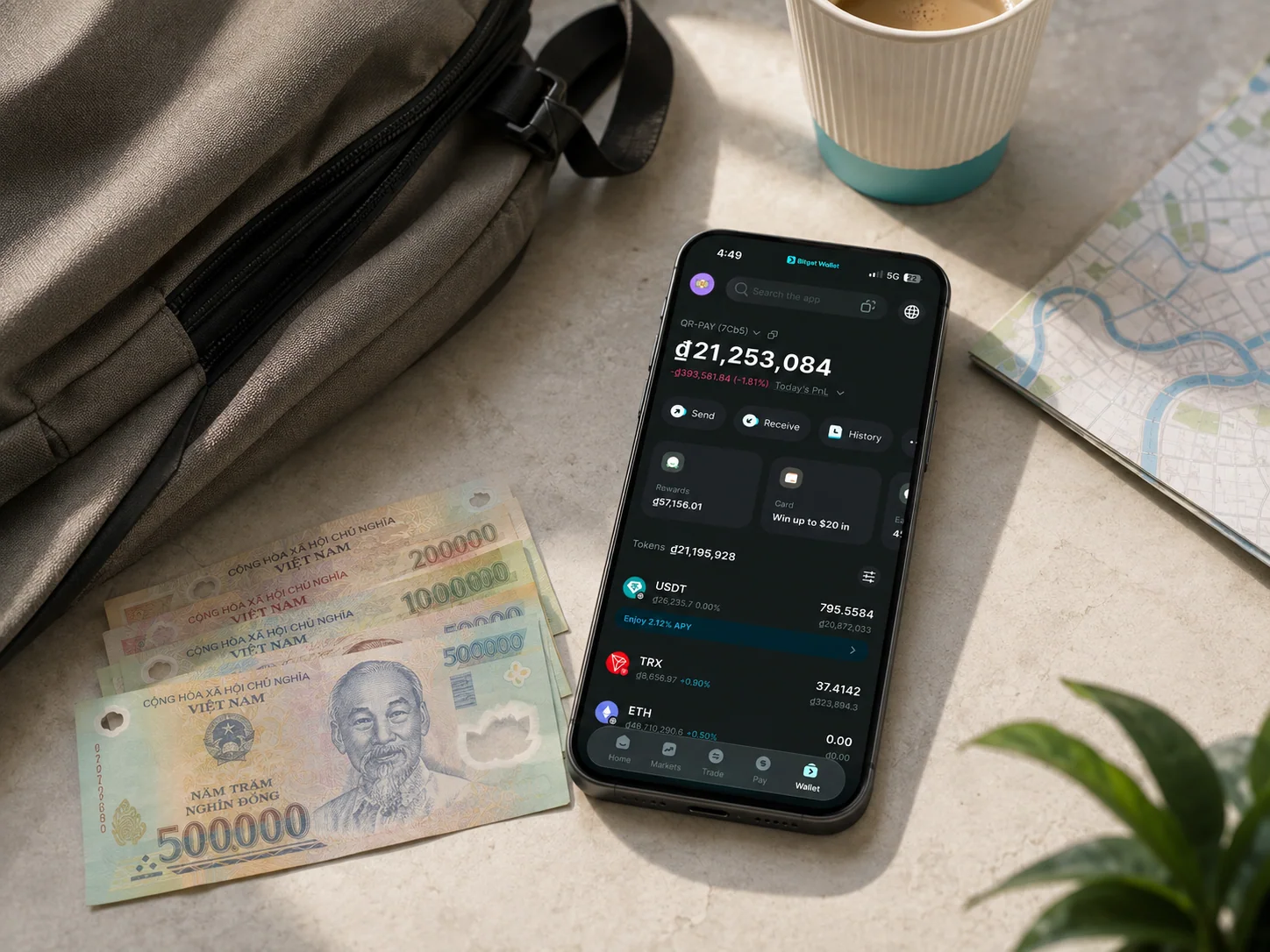
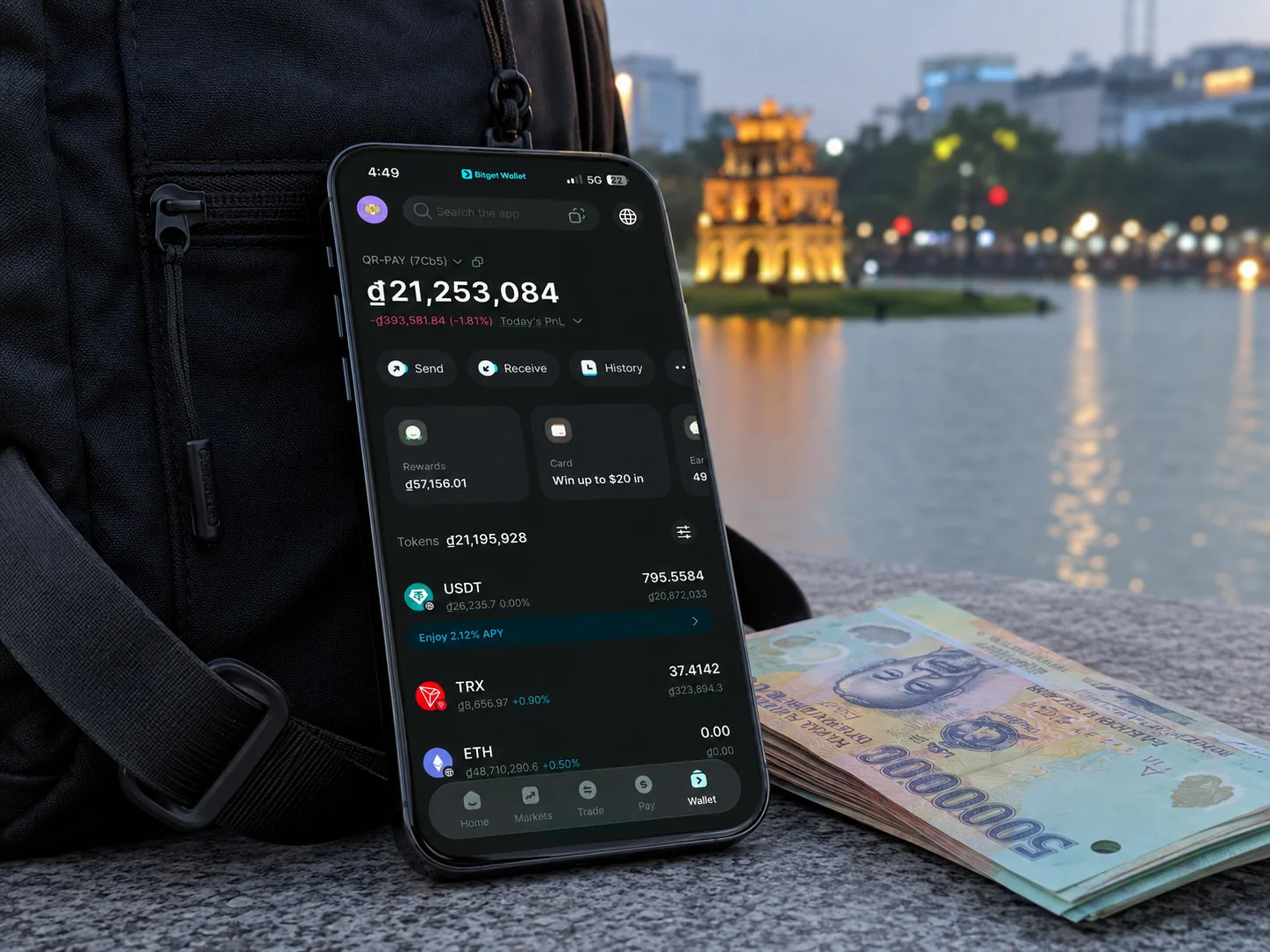
We ended up keeping several tools for ourselves: cash, regular cards where available, and a separate digital backup plan. Among such tools, we tested Bitget Wallet—not as a "magic button" but as an additional wallet for when regular banking options are inconvenient.
If you register, you can use our code bdJX0fBx
Link: Register Bitget Wallet
Again: this is not advice to store all your money there or a recommendation to buy cryptocurrency. It's just one of the working tools worth studying in advance if you understand why you need it.
Separately About the Bitget Exchange
A wallet and an exchange are not the same. If you need an exchange account for trading, P2P, or other operations, you can separately Register on Bitget.
But here it's especially important not to act automatically. Before registering and especially before transferring money, check:
- service availability in your country;
- KYC requirements;
- fees;
- limits;
- P2P rules;
- withdrawal methods;
- blocking risks;
- tax and legal questions in your jurisdiction.
For an ordinary tourist, this may be excessive. For someone living between countries and already understanding how such tools work, this may be one element of the financial system.
What to Prepare Before the Trip
Before flying to Vietnam, it's better not to leave money "for later." A minimal set:
- Cash dollars in good condition.
- A small reserve of dong, if possible to buy in advance.
- A working foreign card.
- Access to online banking without a Russian SIM card as the only factor.
- A backup SIM or eSIM.
- A clear way to receive money from relatives.
- A passport scan and backup documents.
- One or two digital tools if you really know how to use them.
Especially check two-factor authentication. A common mistake: a person leaves, the Russian SIM doesn't work, the bank asks for SMS, and access to money becomes harder.
How to Store Money on the Spot
Don't keep everything in one place. Divide:
- daily cash;
- a cash reserve separately;
- a card separate from the passport;
- backup access to accounts;
- document copies;
- a small amount for emergencies.
On trips, the whole system rarely breaks at once. Usually, the problem is in one link: the card didn't work, the ATM didn't dispense, the phone died, the SIM doesn't work, the limit is over. If there's a backup, it's just an inconvenience. If there's no backup, it's a crisis.
Short Conclusion
It's better to go to Vietnam not with one payment method but with a small financial system. Cash, a working card, a clear way to top up, a backup transfer, and a digital tool for emergencies.
Bitget Wallet in this system may not be the main but a backup option worth studying in advance. If you decide to try, you can Register Bitget Wallet. For an exchange account—separately Register on Bitget.
The main thing is not to arrive in Vietnam with the thought "I'll figure it out somehow." Money is not the part of the trip where you want to improvise on the very first evening.